
Advice | 17 Comments |
Stroke survivors living in fear
Fear of having another stroke
Research from the Stroke Association shows nine out of ten stroke survivors (more than one million people in Britain) live in fear of having another stroke.
This leaves them scared to go out alone and fearful about making a recovery in the aftermath of their stroke. The fear itself can be an impediment to recovering after a stroke.
Click here for top tips on supporting a stroke survivor
• One in five stroke survivors said they kept their fears to themselves and didn’t talk to anyone
• Over a third (37%) of these stroke survivors said they didn’t want to worry anyone; they were too afraid (27%) or didn’t want to sound stupid (26%) by talking about their fears.
On top of dealing with these fears and concerns, the study also shows that many stroke survivors are facing their recovery alone. This leads to a bleak attitude to recovery, with almost nine in ten (88%) survivors afraid they won’t get better and four out of five (80%) fearing they would get sent to a care home when they first had their stroke.
Fear prevents people from getting out and about and meeting others, two of the key factors that stroke survivors have said are integral to their recovery.
Juliet Bouverie, Chief Executive of the Stroke Association, said:
“These stats are truly shocking. I am heart-broken to hear that stroke survivors felt they couldn’t speak to those closest to them about their biggest worries and fears. When you live in isolation, too afraid to leave the house and are unable to ask for help, your motivation can disappear, and can leave you in a very bad place emotionally – feeling like a prisoner in your own home.
“It takes a team to rebuild lives after stroke. When stroke strikes, part of your brain shuts down, and so does a part of you. Recovery is tough, but with the right specialist support, the brain can adapt after stroke. I’ve heard countless stories, and know countless people who, after many years continue to make remarkable recoveries. The first step to eliminating fear is to ask for help and support. If you are a stroke survivor, this could mean speaking to your doctor or social worker to get some answers. If you know a stroke survivor, reach out, ask them how they’re feeling. No one should have to live their life in constant fear.”
The Stroke Association’s research also found that:
• Only 18% of stroke survivors were confident that they would get enough support to make a good recovery
• 87% of stroke survivors said they feared losing their independence
• 81% of stroke survivors said they were afraid they wouldn’t be able to look after their children or parents
Widespread ignorance about stroke
Stroke is the primary cause of disability in the UK – it affects both men and women and can occur at any age, yet it seems that we don’t know much about it, generally speaking.
For example, another study by the Stroke Association found that more than a quarter of the adult population don’t know that a stroke occurs in the brain.
And more than four fifths of those who know a stroke survivor personally say that better understanding of stroke would help them to support the person more effectively in their recovery.
The research also found that of those who know someone personally who has had a stroke:
• 95% agreed that family and friends play an essential role in the recovery process.
• 46% would like to do more to help the stroke survivor, but lack the knowledge to do so.
• Nearly a fifth (18%) say they do not properly understand the overall impact of the condition.
In a separate survey of stroke survivors, 85% said the people they had daily contact with did not understand the impact of the stroke.
This ‘knowledge gap’ is preventing survivors from getting the support they need from those closest to them, and stopping them making the best possible recovery to rebuild their lives after stroke.
The Rebuilding Lives campaign
The Stroke Association’s Rebuilding Lives campaign highlights the challenges faced by stroke survivors and those who support them with their recoveries. Other findings reveal the damaging effects that stroke can have on social networks and relationships:
• More than one in 10 respondents admitted to seeing the survivor less after their stroke.
• More than one in six of those who know a stroke survivor spend less time with them because they don’t consider them the same person following the stroke.
• A quarter of respondents said there had been a drop in social activity on the part of the stroke survivor.
Juliet Bouverie, Chief Executive of Stroke Association, comments:
“A stroke happens in the brain, the control centre for who we are and what we can do. The impact varies depending on which part of the brain is affected. It could be anything from wiping out your speech and physical abilities, to affecting your emotions and personality. So, it’s a real challenge for everyone as they come to grips with this sudden and life changing event. These findings highlight the complexity of stroke and raises the desperate need amongst people to understand the impact of stroke in order to better support their loved ones.
“There are over 1.2 million stroke survivors living in the UK – many of whom are reliant on their friends and family, from help with daily living to understanding their emotional and mental health needs.
“It doesn’t have to be this way. We’re urging those people who know someone who has had a stroke to help turn this around and fill this knowledge gap. Reach out to the Stroke Association for help, so that together we can support stroke survivors to rebuild their lives.”
Top tips for supporting stroke survivors
1. Be patient
Let the stroke survivor do things in their own time. If there’s something frustrating you, explain the problem calmly and focus on what you can both do to make it better.
2. Don’t over-complicate
The stroke survivor may find it hard to concentrate or remember things. Help them in the right way: break tasks down into individual steps, give simple instructions, one at a time, rather than a list of things to do. Get to the point.
3. Encourage
Practise exercises with the stroke survivor and think of ways to make them fun. Cooking a meal can be a good way to practise planning and problem-solving, for example. If progress is slow it can be easy to think that things will never get better, so help them by celebrating all their successes, however small.
4. Don’t do everything for them
It’s normal to want to do as much as possible for your loved one. But it will be better if you help them to do things on their own rather than do it all for them. So, if they ask you what day it is, suggest they look at the paper to find out. Perhaps lay their clothes out, so they may be able to dress themselves, or put out ingredients to make a sandwich.
5. Help them get support
Cognitive problems are often missed by doctors and sometimes it can be difficult to get them taken seriously. However, you need to trust that you know your friend or loved one better than they do, so don’t be afraid to keep pushing to get the support you need. If you don’t think you’re getting the right support from your doctor or stroke team, you can call the Stroke Helpline on 0303 3033 100.
6. Find new ways to communicate
If the survivor isn’t able to communicate in the same ways as before, then you’re going to need to learn new ways to do it too. Ask them what helps. Get involved with their speech and language therapy as much as you can. Many people with communication problems say they feel invisible because people forget that they have something to say or aren’t willing to put the effort in to find out. Make sure you include the person in activities and conversations.
These are key factors that increase the risk of stroke:
• Obesity – makes you more likely to have high cholesterol levels and develop heart disease, or diabetes, all of which can lead to a stroke
• Heart problems — Strokes are six times more likely to occur in people with cardiovascular disease
• Atrial fibrillation – which is one of the most common heart rhythm problems, increases the risk by about five times
• High blood pressure — Strokes are between four and six times more likely if you have hypertension.
• High cholesterol — doubles the risk
• Too much alcohol — increases the risk for both stroke and cardiovascular disease
• Smoking — doubles your risk compared to non-smokers
Women also get strokes…
Around 30,000 women die from a stroke every year – it is the third biggest cause of death in women in the UK, and the second most prevalent worldwide.
Risks increase with age, and 20% of women will have a stroke at some stage in their life.
In addition to the lifestyle risks that increase anyone’s likelihood of having a stroke, shown below, there are factors which exclusively affect women, such as pregnancy, birth control pill and hormone replacement therapy.
Limited data available on the impact of mental health
There hasn’t yet been a great deal of research on the link between mental well-being and stroke risk. However, data is beginning to emerge that demonstrates a connection.
A Japanese study analysed 40,000 men and women aged between 40 and 59. It used unemployment as an indicator that someone had been through a period of high stress. The results showed a clear correlation between the stress caused by job loss, and an increase in smoking and drinking; high blood pressure and diabetes.
There was an increased incidence of stroke, not just linked to long-term unemployment, or a series of job losses. Just one experience of losing a job increased the risk of a stroke.
Speed is essential
When a person does experience a stroke, being able to recognise the signs can greatly increase the odds of a better outcome. Time is critical, and time saved can make the difference that allows a person to walk again, or to go home instead of going into a nursing home.
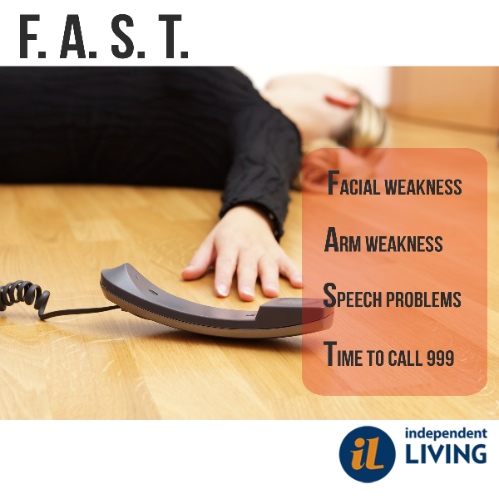
There is a simple way to recognise the symptoms, using the acronym FAST:
• FACIAL weakness: Can the person smile? Has their mouth or eye drooped?
• ARM weakness: Can the person raise both arms?
• SPEECH problems: Can the person speak clearly and understand what you say?
• TIME to call 999.
If a person fails any one of these tests, get help immediately by dialling 999.
The sooner somebody gets medical attention, the better their chances of making a full recovery.
A mini stroke or TIA is also serious
If symptoms disappear within 24 hours, the person may have had a Transient ischaemic attack (TIA), which is also called a mini-stroke. This is serious, and may be a warning sign that they are at risk of stroke, so if you think someone has had a TIA, and didn’t get medical attention, they should see their GP straightaway.
return to top
Further reading and resources
Target for proven stroke treatment missed
For more information about Rebuilding Lives or about Stroke, visit www.stroke.org.uk/rebuildinglives (link will open in a new browser window)
You can read more on the World Stroke Organisation website (link will open in a new browser window)
Our resident nutrition expert, Mary Farmer, has good advice about diet to help you maintain your health and minimise the risks of developing diseases and long-term conditions. Follow this link to the nutrition archive
Stroke survivor aims to be first disabled person to ski solo to the south pole
‘Mild’ cerebellar haemorrhage at 52 exactly a year ago. 5 days in hospital then back on my own in a 1 bed flat. “you’ll be fine'” said the consultant. Er, not quite – still getting ‘waves’ of lightheadedness/head pressure feelings especially when standing/walking, also loud tinnitus and palatal tremor. An angiogram has found a DVA, but a recent CT scan showed no new probs. GP suggests symptoms could be psychological as nothing obvious. I absolutely disagree!! Something still very wrong. I’ve lost most of my job, too unwell to get out into the world/make plans. Faced with having to push for a neurologist referral, maybe private. Knee also needs an big operation I can’t contemplate due to brain stuff. Feel like there’s no point to anything.
My 45 yr old had a massive stroke in 2018 which left her with paralyzed R side ,robbed her speech completely and she suffers from cognitive impairment.
Yet speech therapy is no longer available, she spends her days depressed, in bed.
Where can we turn for help?
Hello Grace
I’m sorry to hear this – it must be very miserable for both of you. If you get in touch with the Stroke Association they should be able to advise you about support that is available: https://www.stroke.org.uk/finding-support
Best wishes,
Frances
I had what my doctor said was a mini stroke or a tia , i was put on 300mg aspirin and was sent home after being told i would get an appointment for further tests at the hospital .
My only symptom was a black veil covering my right eye which only lasted less than a minute .
Unfortunately due to covid and hospital being busy i will not go to the hospital until monday .
I have had no further symptoms so far but feel very anxious .
Following my stroke in August 2020 I have consistently taken my medication reduced alcohol and apart from the occasional cigarette cut out cigarettes. I get an occasional headache feeling of faintness but apart from offering me a blood test my doctor has been very dismissive saying it’s probably a reaction to the meds I’m on. I get that there’s a pandemic but where do I go from here? I ‘ live alone with support of family but they are busy people who believe I made a marvelous recovery. Because I get around am working from home etc. I appear to be coping but where can I get reassurance that all is well?
I go asleep fearing that either I won’t wake up or will wake up with one of the dangerous headaches and be unable to call for help. I’ve had one or two instances of rapid heartbeat where an ambulance was called but after a few hours in casualty I was fine. People close to me say its post-traumatic stress syndrome but how do I know? I had minor breast cancer in February for a nonprogressive tumour and was so looked after I felt almost overly pampered. Why am I so neglected by the medical profession now for this ailment?
Hello Mary
I am sorry to hear of the anxiety you are living with – that must be very difficult.
Have you been in touch with the Stroke Association? They have a dedicated helpline for people who have had a stroke, as well as local support groups. They should be able to help you. All the details are on their website: https://www.stroke.org.uk/finding-support (external link will open in a new browser window)
Good luck and best wishes,
Frances
I have symptoms of having had a stroke – loss of use in my left side – as well as headaches and the added frustration of arthritis in many joints. Over the past 12 years of tests and seeing a neurological consultant there has been no diagnosis as to what is wrong with me. He has confirmed it wasn’t a stroke, although one of my physios said it WAS! Who can I believe. I live on my own and feel very alone and neglected as I feel as if I’ve dropped off the medical radar now that Covid 19 has become such a problem. I’m reluctant to talk with my GPs anymore as they just want to give me painkillers and/or pass me on to someone else. They have acknowledged that they don’t know what else they can do for me. I’m at my wits’ end as I’m virtually housebound and can’t drive or get out without help. I do all my shopping online which isn’t very reliable at the moment and life is just such a chore – I’m feeling very depressed with it all and feel there is no quality of life to look forward to any more. I don’t expect you to be able to help, but just wanted to offload some of my frustrations, which seem to pile up on my head each day.
my mum had a stroke recently and was in hospital for 4 weeks,her speech and mobility is good but she cant understand what people are saying so we have to write everything down,do you think this will come back eventually
Hello Pauline
I’m sorry to hear about your mother’s stroke. The way that people recover from strokes is very varied, and I can’t really comment on her future prospects. Perhaps you could talk to the healthcare professionals treating her for a better idea of the situation.
Generally speaking, most rapid recovery is achieved in the first 3 to 4 months, but some people continue to improve over a year or two. Everyone is different!
The Stroke Association is a helpful source of advice and support. https://www.stroke.org.uk/ (external link will open in a new browser window)
Good luck and best wishes
Frances
a stroke survivor clot removed. Financial ruin. Family stressed in financial help loss of joy for life grand children give me a reason to shower & brush my teeth and eat nutrients so i can see them when they knock onte door. I live with adult chidren who take care of me. I can walk and talk. Mental health challenged been fired numerout times. Hard to get out of bed especially on rainy days. Isolate to protect myself from anyone who doesn’t understand or who i dont want to be a burden to
[Slightly edited for clarity]
I had a sub-arachnoid brain haemorrhage in 1999. It was misdiagnosed by the local hospital as a migraine! That after a week of the worst headache I’d ever had in my life, unresponsive 2 over-the-counter pain killers, n projectile vomiting, (a classic symptom). I was fortunate in that another doctor came on duty, recognised it for what it was, did a lumbar puncture, found blood in the spinal fluid n rushed me off 4 an emergency op at the Royal Neurological Hosp in London, where I had several aneurysms clipped, not without having a stroke during the op tho. I returned 2 a specialist unit @ the Homerton Hosp in London, where I learnt 2 walk again using a zimmer frame, n then was transferred 2 another unit of the Brain Injury Research Trust @ Milton Keynes. I continued being able 2 walk, using a travelator supplied by the local hosp, bt found it hard being there due 2 the behaviour of others who’d had different brain injuries. They were often violent, or went around exposing themselves. I had moved 2 that facility 2 be near 2 my boyfriend who lived in Northampton, who had been v supportive during the stroke, bt never came 2 see me n ended the relationship by letter. During this period I also had 2 cope w my brother dying suddenly of an aortic stroke, n I was also having 2 cope with losing my job as a curator @ the British Museum, where I’d been for 26yrs.My parents, unbeknown 2 me re-homed my 2 beloved cats without permission, so it was one loss after another! Carer just arrived so will resume later
I am so sorry to hear of your experience, Cathy – so many blows to cope with, and all as a result of your stroke.
I hope that life is a bit easier for you now, so many years later.
Best wishes,
Frances
Thnx. The Stroke Assoc did kindly provide money 4 a counsellor, bt that of course was short-term. My main complaint is the lack of nhs lòng-term physio 2 help me start 2 walk again. Don’t have family nearby, all I have left is 96yr old frail dad n disabled sister, losing her sight due 2 Type 1 diabetes, down in Kent. Friends neighbours nearby have been v supplortive, others faded away like snow in summer!
What does awaiting moderation mean plse?
Just means that posts are viewed and approved by one of the team before being published on Independent Living!
My stroke came to me out of the blue, I had low cholesterol 4.9ppm . My stroke type was a Thalamic stroke, it has left me with cognitive function problems and body temperature problems. 8 months have gone by since it happened, i returned to work but I am finding it difficult to adjust to full-time hours , I am a 63-year-old man.
Thank you for sharing your experience of stroke, Mr Bunting. Another reminder that it can strike anyone at any time, without warning. I hope that you recover more fully with a bit more time.