
Industry News | Sep 26, 2026 | 1 Comment |
Organ donation – NHS urgent response
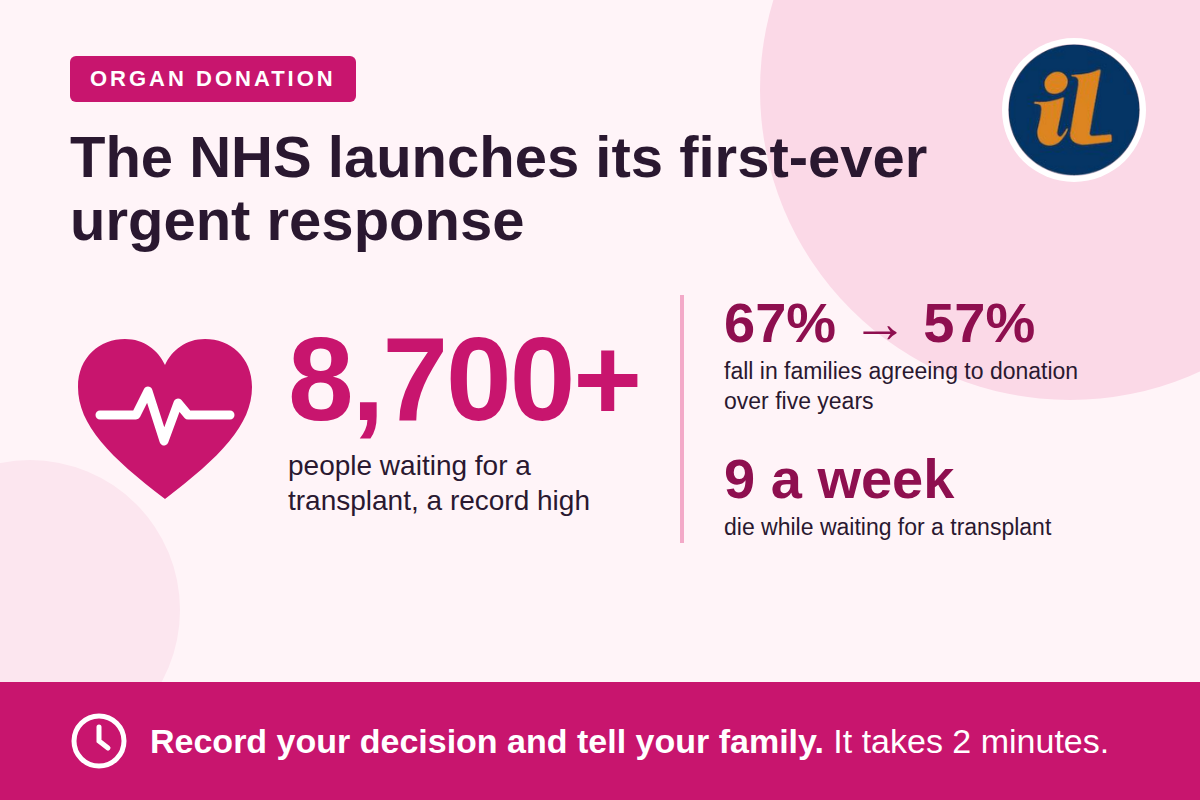
Organ donation: NHS launches first-ever urgent response
(external links below will open in a new browser tab or window)
Organ Donation Week (21 to 27 September 2026) opened with stark news: NHS Blood and Transplant (NHSBT) has, for the first time ever, put organ donation on an urgent footing, after a sharp fall in the number of donors across the UK.
Deceased donation is currently running 9% below the same point last year, while the transplant waiting list has climbed past 8,700 people – the highest figure on record. Nine people die every week while waiting for a transplant.
Why donations are falling
Only around 1% of people in the UK die in circumstances where organ donation is possible, and NHSBT says that pool of potential donors has shrunk by around a fifth since 2019/20.
At the same time, fewer families are saying yes. Family consent has dropped from 67% in 2020/21 to 57% last year. The deciding factor is often simply whether a family knows what their relative wanted: when they do, families support donation around 90% of the time, but that falls to around half when no decision is known.
New NHSBT figures show that between April 2021 and March 2026, more than 700 potential donations did not go ahead because families were unsure of their loved one’s wishes. With an average of three organs per donor, that adds up to more than 2,100 lost chances of a transplant.
What the urgent response involves
NHSBT is working with NHS trusts across the UK on a set of accelerated measures, including:
• Identifying and referring more potential donors, so that no opportunity is missed.
• Improving testing for neurological death, to cut delays and uncertainty.
• Faster action to improve family consent rates.
• Making the most of every viable donation opportunity in hospital.
• Speeding up improvements right across the donation pathway.
Longer term, it is developing a transformation programme that includes expanding donation after circulatory death, new techniques to make better use of the organs that are available, and a stronger living donation programme.
NHSBT is also calling on one million people who have never registered to record their decision on the NHS Organ Donor Register this year.
Anthony Clarkson, Director of Organ and Tissue Donation and Transplantation, NHSBT, said:
“We are facing one of the most challenging periods for organ donation in over a decade.”
Ollie and Miriam
Among the families supporting the campaign are Hannah and Mike Jolliff from Dorset. Their son Ollie was born with a genetic condition that stopped his liver processing protein; his older brother Kieran had died of the same condition at the age of four, before a transplant was possible. Ollie spent 11 months on the waiting list before a matching liver was found, and the call came on what would have been Kieran’s tenth birthday.
Ten years on, Ollie is about to start his last year of primary school and competes every year at the British Transplant Games. His donor was 17-year-old Miriam Lee, who died suddenly of a cardiac arrest. Miriam had joined the Organ Donor Register when she signed up to give blood, and had told her parents what she wanted – which, they say, meant they knew they had to honour it. Her kidneys, liver, pancreas, corneas, ligaments and bones were all donated.
Opt out: what it does and doesn’t mean
Every UK nation now has an opt out system
Wales led the way in December 2015, followed by England in May 2020, Scotland on 26 March 2021 and Northern Ireland in June 2023. Unless you have recorded a decision not to donate, or you are in an excluded group, you are considered willing to be a donor. In Scotland the law is known as “deemed authorisation” and applies to most adults aged 16 and over.
Your family is still always asked
Opt out does not remove families from the process. Donation cannot go ahead without their support, which is why the fall in family consent matters so much – and why a recorded decision, and a conversation, make such a difference.
Who the opt out doesn’t apply to
In Scotland, deemed authorisation does not apply to adults who lack the capacity to understand the law (which may include some people with advanced dementia or a learning disability), people who have lived in Scotland for less than 12 months, or children under 16. If someone in these groups could donate and hasn’t recorded a decision, their closest family member is asked instead. Scottish law does not allow you to nominate someone else to make the decision on your behalf.
Five years on in Scotland
Opt out was expected to increase the number of donors, but the UK-wide figures above show consent falling over the very years it has been in place. A change in the law, it seems, is no substitute for families knowing what their loved one wanted.
Can I donate if I have a disability or a health condition?
Very often, yes. There is no upper age limit for registering, and having an illness, disability or long-term condition doesn’t automatically rule you out. Specialists decide at the time which organs and tissue are suitable, based on each person’s medical history. Only a handful of conditions rule out donation completely, such as CJD, Ebola and active cancer. Even where organs can’t be used, it may still be possible to donate tissue such as corneas.
The message from NHSBT is not to rule yourself out in advance: register your decision and let the medical team make the call.
Living donation matters too. According to Kidney Care UK (external link will open in a new browser tab or window), living donors make one in three kidney transplants possible, and last year almost 1,000 people donated a kidney or part of their liver.
What you can do
• Register your decision on the NHS Organ Donor Register if you live in England, Wales or Northern Ireland. You can also call 0300 123 23 23 (24 hours a day) or use the NHS App. It takes about two minutes, and you can choose to donate, opt out, or donate only certain organs.
• If you live in Scotland, you can register your decision through Organ Donation Scotland, which also explains your choices under the Scottish system.
• Tell your family and close friends what you have decided.
• If you care for someone, it can be a natural conversation to have alongside other plans for the future, such as an advance decision.
Article ends – click to return to top or check out related resources below
Further reading and resources
Advance Decisions
NHSBT: first-ever urgent response announcement (external link will open in a new browser tab or window)
NHS Organ Donation: who can donate? (external link will open in a new browser tab or window)
Independent living seems like a wonderful option for older adults who want to spend less time worrying about household responsibilities and more time enjoying the things they love.