
Protein powder in the accessible kitchen: a practical guide for difficult cooking days
This is a sponsored article, produced in partnership with Naked Nutrition.
Ask anyone who has spent a winter managing a flare-up, a few months with one arm in a sling, or years pacing their energy around a fatiguing condition, and they will tell you the same thing: the hard part of eating well is rarely knowing what to eat. It’s the doing. Standing at a hob long enough to cook. Opening the jar. Lifting a pan of water off the heat. Getting the shopping home. And then, at the end of it, washing up a blender with a lid that needs two strong hands to twist off.
Protein powder is usually discussed in the language of gyms and personal bests, which is a shame, because it stops a lot of people from noticing what it actually is when you look at it as a kitchen product. It is a shelf-stable dry ingredient, sold in a tub, that can be stirred into food you are already making without any chopping, cooking or heavy lifting. For someone with reduced grip, limited standing tolerance, a small appetite or a carer trying to get something nourishing into a difficult afternoon, that combination of qualities is worth understanding on its own terms.
This article is about those practicalities – texture, packaging, cost, storage, how to mix it without a blender – rather than about what protein powder might or might not do for you. Whether you need more protein, and how much, is a question for your GP or a registered dietitian, and it matters more than usual if you have a kidney condition, a fluid restriction, swallowing difficulties, or are already under the care of a dietetic team.
What’s actually in the tub
Pea protein powder is not made from the sweet green peas you eat with your dinner. It comes from yellow field peas, dried, starchy split peas of the same species, grown as a broadacre crop mainly in Canada, France, Belgium and the northern United States. The peas are milled, the protein is separated from the starch and fibre, and what’s left is dried into a fine, pale beige powder.
That separation can be done mechanically, using water, or with the help of solvents. It’s worth reading the label to see which, because it tends to correlate with what else has been added afterwards.
An isolate is typically somewhere north of 80% protein by weight, which is why a small scoop goes a surprisingly long way. On a 450g tub, you’re generally looking at around 15 servings, a useful thing to know when you’re comparing the shelf price of one tub against another.
Five things about peas most people don’t know
They fertilise their own field. Peas are legumes, which means they host bacteria in root nodules that pull nitrogen out of the air. A pea crop needs little or no nitrogen fertiliser and leaves the soil better than it found it, which is why peas are so often used in crop rotations.
Pea protein and porridge are chemically complementary. Peas are unusually rich in the amino acid lysine, which cereals are short of, and comparatively low in methionine, which cereals have plenty of. Oats, rice and bread cover exactly the gap peas leave, and vice versa. Stirring pea protein into porridge isn’t just convenient; the two ingredients genuinely complete each other’s amino acid profile.
It survives the oven. Pea protein is notably heat-stable, which is why it behaves well in baking and in hot food. Some dairy proteins clump or go stringy when they hit heat or acidity; pea protein is far more forgiving, and will go into a hot soup or a mug of cocoa without curdling.
The “earthy” taste is a live research topic. That faint green, slightly beany note is caused by volatile compounds released during processing, and food scientists have published a genuinely large body of work on removing it. Nobody has entirely won yet, which is why unflavoured pea protein still tastes faintly of peas.
It disperses rather than dissolves. Unlike sugar or salt, protein powder doesn’t truly dissolve, the particles are suspended in the liquid. That’s the whole explanation for the slight graininess people notice, and it’s also why the mixing technique below makes such a difference.
Getting it into a glass without a blender
This is where the accessibility gains are, and most of them cost nothing.
Wet first, always. Put the liquid in the container before the powder, never the other way round. Powder hitting a dry surface forms lumps that then need vigorous shaking to break up, which is precisely the thing you may be trying to avoid.
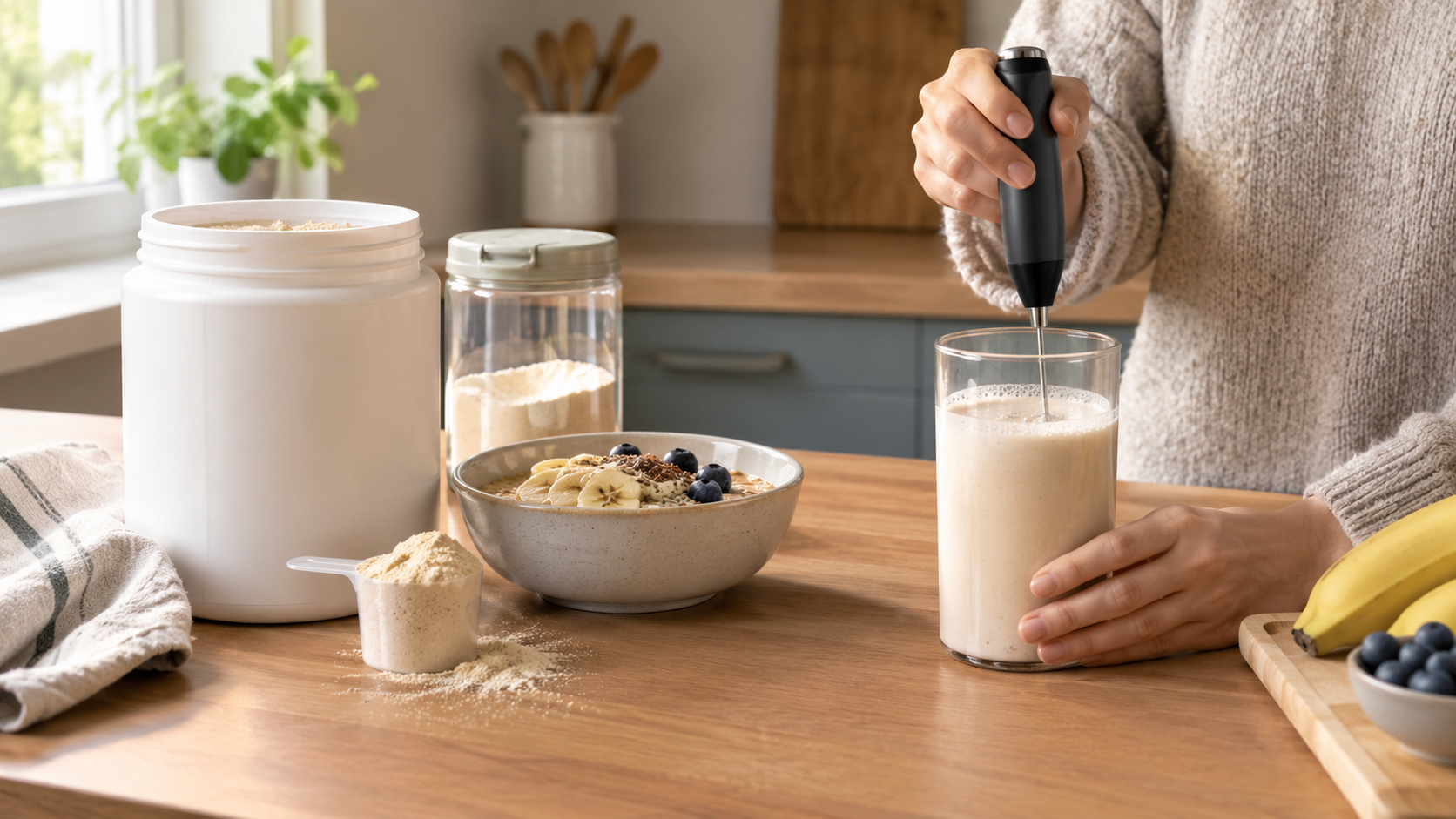
Use a battery milk frother. A £10 handheld frother is, for many people, a far better tool than a shaker bottle or a blender. It takes one hand, requires no grip strength, no lid to twist, no jug to lift, and it rinses under the tap in five seconds. It is the single most useful piece of kit to suggest to anyone with reduced hand function.
Decant on a good day. Factory tubs often have wide screw lids and a scoop buried somewhere in the powder. On a day when your hands are cooperating, decant into a container you can actually open, a flip-top storage jar, or several small pots each holding one portion. Pre-portioning removes the fiddliest step from the days when you have least to give.
Stir it into what you already eat. A shake is only one option, and often not the best one. Unflavoured powder disappears into porridge, mashed potato, soup, custard, yoghurt, pancake batter, scrambled egg and hot chocolate. If appetite is the limiting factor, adding to a small portion of something familiar tends to work better than presenting a large glass of something new.
Sit down to do it. Obvious, and routinely ignored. A perching stool at the worktop, a non-slip mat under the container, and a long-handled spoon turn a standing task into a seated one.
Watch the scoop, not the spoon. Scoop sizes vary enormously between brands, and a “serving” on one tub may be double another. If you’re tracking anything at all, check the grams rather than counting scoops.
Where powders sit alongside real food
They sit second. The consistent message from dietitians working with older and disabled people is a “food first” approach: enriching ordinary meals with ordinary ingredients – full-fat milk, cheese, butter, nut butters, milk powder, cream – before reaching for anything from a tub.
That advice exists because the underlying problem is bigger than most people realise. The British Dietetic Association’s Food Fact Sheet on spotting and treating malnutrition (external link will open in a new browser tab or window) notes that around three million people in the UK are malnourished or at risk of malnutrition, and that the majority of them are living in their own homes, not in hospitals or care settings. Their sheet is genuinely worth reading in full, and worth printing for anyone caring for a relative whose appetite has quietly shrunk.
It’s also worth being clear that a shop-bought protein powder is a different category of thing from the oral nutritional supplements a dietitian may prescribe. Those are formulated to a specification, contain a full range of vitamins and minerals, and are prescribed for a reason. If someone is already on prescribed supplements, powders shouldn’t be substituted in without speaking to the dietetic team first.
And for anyone with swallowing difficulties, a note of real caution: adding powder changes the consistency of a drink in ways that matter clinically, and it is not a substitute for a prescribed thickener. That’s a conversation for a speech and language therapist, not a decision to make from a tub label.
What to look at when you’re buying
Once you’ve had that conversation and decided a powder has a place in your cupboard, the buying decision comes down to a handful of practical checks.
The ingredients list. Shorter is easier to assess. A single-ingredient product tells you exactly what you’re getting; a list of fifteen items with sweeteners, gums, flavourings and anti-caking agents requires more work to unpick, and matters more if you have intolerances or are managing someone else’s diet. Naked Nutrition’s 450g pea protein powder (external link will open in a new browser tab or window), for instance, lists a single ingredient: pea protein from yellow split peas, mechanically water-extracted, packed in Belgium, with no sweeteners or flavourings, and independently tested for heavy metals. Unflavoured products like this are also the more useful ones for stirring into savoury food, where vanilla or chocolate would be unwelcome.
Cost per serving, not per tub. Divide the price by the number of servings. The figure that matters is what one portion costs you, and larger tubs are usually cheaper per serving, but only if you can lift and store them.
The physical tub. How heavy is it full? Can you get the lid off? Will it fit in the cupboard you can actually reach, or will it live on a high shelf where it becomes a two-person job? This is the consideration people forget and then regret.
Allergens and testing. Pea protein is naturally free from gluten, dairy and soya, which makes it a straightforward option for coeliac or lactose-intolerant households, but always check the packaging for cross-contamination warnings if that’s clinically important to you. Independent third-party testing for heavy metals is a reasonable thing to look for in any plant-based powder, since plants take up what’s in the soil they grow in. Brands like Naked Nutrition (external link will open in a new browser tab or window) publish their testing approach, and it’s a fair question to put to any manufacturer who doesn’t.
The practical summary
Protein powder isn’t a health product with a story attached. It’s a dry ingredient with some useful properties: it keeps for months, needs no cooking, weighs almost nothing per portion, stirs into food you already make, and can be handled one-handed with the right container and a £10 frother.
For someone rationing energy across a day, or a carer looking for ways to make a small meal count, those are real, boring, practical advantages, and they’re the right reasons to consider it. Whether it belongs in your diet at all is a question for a professional who knows your medical history. What goes on your worktop, and whether you can open it, is entirely yours to decide.
Article ends – click to return to top or check out related resources below
Further reading and resources
How to tackle malnutrition?
Malnutrition on the rise
Eating & Drinking Aids
Dysphagia – problems with swallowing
Protein powder can be a practical way to add protein to everyday meals, especially when kitchen tasks need to be simple and accessible.
Choosing easy-to-use products and suitable portions can support a balanced diet without adding unnecessary preparation.