
Industry News | Oct 03, 2026 | No Comments |
Britain’s first Workplace Health System
Plans unveiled for Britain’s first Workplace Health System
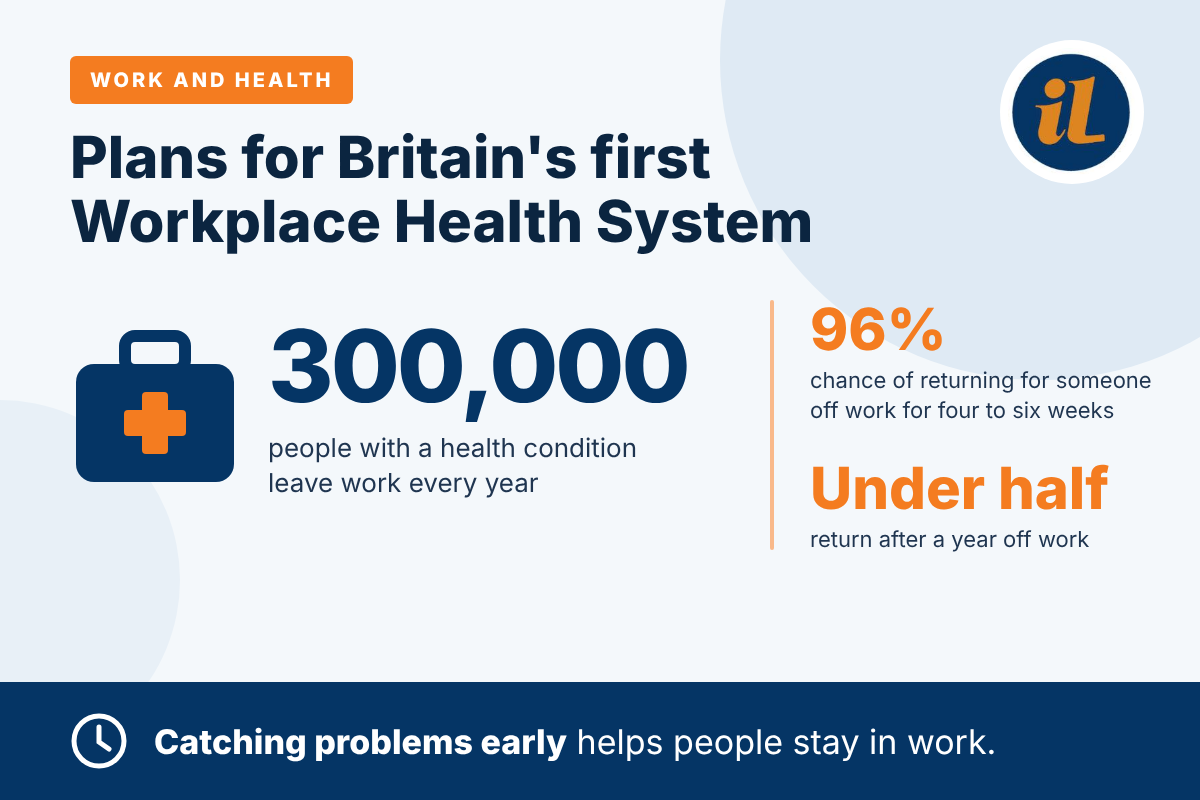
Every year, around 300,000 people with a health condition leave their job. A new government-backed plan aims to stop many of them falling out of work in the first place, by catching problems earlier and making good workplace health support available to small firms, not just big companies.
The plan, published on 23 September 2026, is the latest update from Sir Charlie Mayfield, author of the Keep Britain Working Review and co-chair of the Keep Britain Working programme. It sets out how employers, the NHS, local councils and other services will be brought together into what is being described as Britain’s first Workplace Health System.
At a glance
Why it matters
• Around 300,000 people with a health condition leave work every year.
• Someone off work for four to six weeks has a 96% chance of returning. After a year, fewer than half do.
• Since 2019, the number of working-age people out of work because of ill health has risen by 800,000, costing the economy around £212 billion a year.
What’s being done
• Eleven regional “Vanguards” and more than 200 Vanguard organisations are testing the new system across all four UK nations.
• An employer standard is being developed with the British Standards Institution (BSI).
• Pooled buying and insurance routes are planned so smaller firms can afford occupational health support.
• A new employer data project and a work and health prototype are being developed this autumn.
Acting early, before a job is lost
The central idea is prevention. The longer someone is off sick, the less likely they are to go back, so the plan focuses on spotting health problems early, keeping in touch during absences, and planning a return to work before a health condition turns into a lost job.
It also aims to build more inclusive workplaces, so that people with health conditions or disabilities get the support they need to stay in work, and to give employers better data on how well they are doing.
Sir Charlie Mayfield, author of the Keep Britain Working Review and Co-Chair of the Keep Britain Working programme, said:
“We’ve had a National Health Service for almost 80 years. We’ve never had a Workplace Health System. That is why the same people appear on the welfare bill, on NHS waiting lists and in the productivity figures without anyone being able to join them up. It’s also why we are missing the best moments to help people. The new Workplace Health System would change that.”
Testing it out across the UK
The eleven regional Vanguards include nine mayoral authorities (East Midlands, Greater London, Greater Manchester, Liverpool City Region, the North East, South Yorkshire, the West Midlands, the West of England and West Yorkshire) plus Cornwall Council and Worcestershire County Council. They are working with employers, unions and disabled people to build and test the new system. Examples include:
• Liverpool City Region is testing draft return-to-work plans developed with employers.
• Hull City Council, with provider Latus, has created the Hull Resilience Hub, a buyer’s pool that lets local small businesses access occupational health services at the same prices as large companies.
• South Yorkshire will trial independent case workers based part-time within businesses, supporting employees with health concerns.
Steve Rotheram, Mayor of the Liverpool City Region, said:
“People shouldn’t be written off because they develop a health condition – and businesses shouldn’t have to lose good, experienced workers because the right support wasn’t there soon enough.”
A standard for employers
Few employers can currently tell how well they keep staff with health conditions in work, or whether those staff are still in work six months later. To help close that gap, a new employer standard is being developed with BSI. Over the next year the programme will keep working with BSI on the standard, and will test and refine employer commitments with the Vanguards to build evidence on what works.
This comes on top of the government’s overhaul of the Disability Confident scheme, which Sir Charlie’s original review found “lacks teeth”. Those reforms are also being trialled alongside the Vanguards. The latest announcement doesn’t say how the new BSI standard will fit with Disability Confident, which around 19,000 employers have already signed up to.
BSI’s own research highlights why workplace culture matters: nearly half of staff who don’t feel confident raising health concerns with their employer have left a role or taken extended leave as a result.
Anne Hayes, Director of Standards Development, BSI, said:
“The standard we are developing with KBW will be a vital tool to help employers work effectively to build workplace cultures rooted in trust so that individuals and organisations alike can flourish.”
Part of a wider employment support package
Sir Charlie’s work sits within a £3.5 billion employment support package, which includes:
• WorkWell, backed by £259 million, supporting up to 250,000 people to stay in or return to work.
• Connect to Work, which will reach 300,000 sick or disabled people with tailored support.
• More than 1,000 full-time Pathways to Work advisers, already in place across Britain.
Work and Pensions Secretary Pat McFadden said:
“Too many people fall out of work because of a health problem that could have been caught earlier, and too many employers have no way of knowing whether they are getting this right.”
Ally McGovern, Minister of State for Work and Health, said:
“Anyone can find themself with an illness that could stop them working. Getting help quickly rather than waiting for the problem to get worse is the right way to support good health and a strong economy.”
What happens next
The government says further welfare reform will be guided by the Milburn and Timms reviews, both due to conclude later this year. You can follow the latest on the Timms Review of PIP on our rolling update page.
If you have a disability or health condition and need support to stay in work now, the government’s Access to Work (external link will open in a new browser tab or window) scheme can help pay for practical support, such as specialist equipment, travel to work or mental health support. Grants don’t need to be paid back.
Read the full government announcement: New plan for Britain’s first Workplace Health System (external link will open in a new browser tab or window), and the report itself: Keep Britain Working: A National Growth Opportunity (external link will open in a new browser tab or window).
Article ends – click to return to top or check out related resources below
Further reading and resources
Get Britain Working: where the plans began (Dec 2024)
Disability Confident scheme lacks teeth: the planned overhaul
Connect to Work programme
WorkWell programme
The Timms Review: latest updates on the PIP review
Employment and Support Allowance (ESA) explained
More news and guides on work and employment
Be the first to comment.