
Industry News | Oct 10, 2026 | No Comments |
Digital Done Right
Digital Done Right: Age UK says recognition is not enough
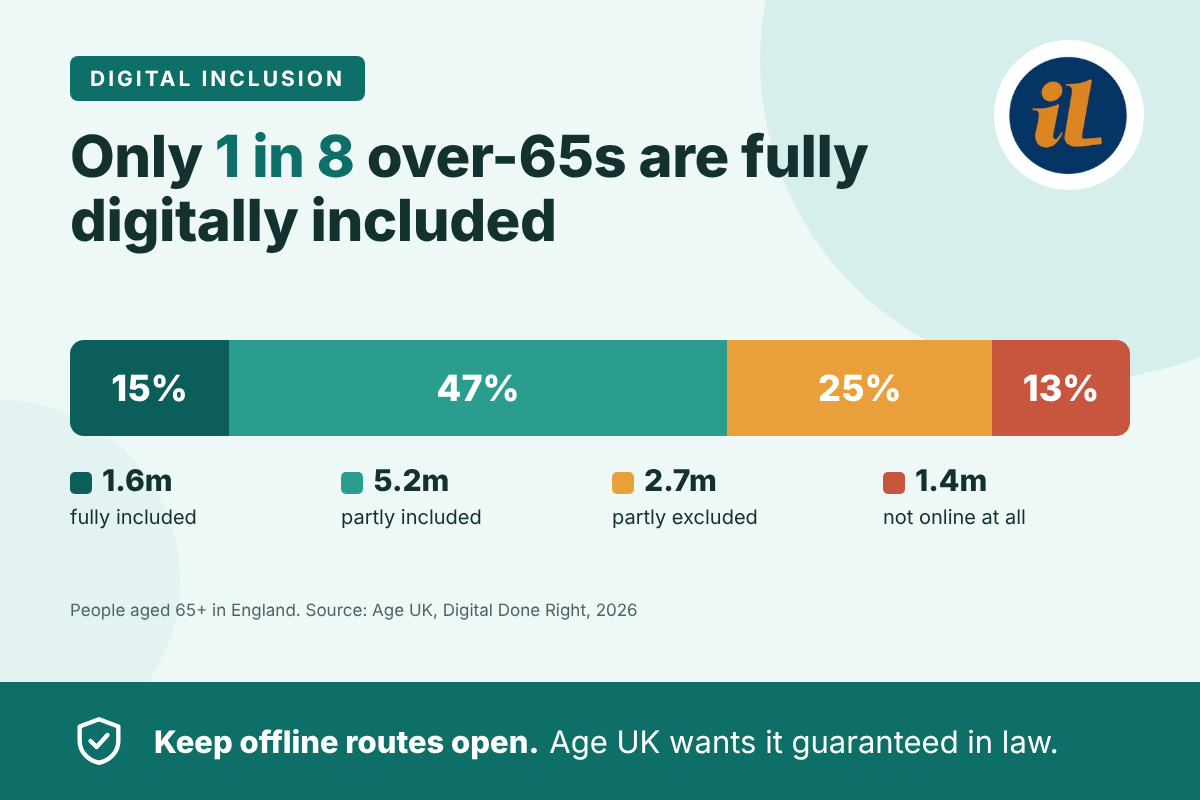
Only one in eight people aged over 65 in England has the confidence and skills to use digital technology with ease, according to new analysis from Age UK. Its report, Digital Done Right, argues that the usual picture of older people being either “online” or “offline” is far too simple, and that millions sit somewhere in the middle, managing some things online but struggling with others.
The government has now responded, agreeing with key parts of the report. But Age UK says warm words are not enough, and is pressing ministers to guarantee in law that essential services, including face-to-face banking, will always have an offline route.
At a glance: where over-65s in England sit on the digital spectrum
• Digitally included: 15% (1.6 million). Confident online at home and out and about, including banking and managing NHS care, without help.
• Partially digitally included: 47% (5.2 million). Mostly online at home. Most bank and shop online, but only just over half manage their healthcare online, and around a third sometimes need help.
• Partially digitally excluded: 25% (2.7 million). Usually online at least weekly, but for a narrower range of tasks. About one in three bank online, under one in four manage healthcare digitally, and most need help some or all of the time.
• Digitally excluded: 13% (1.4 million). Do not go online at all.
Source: Age UK analysis of the English Longitudinal Study of Ageing (2023-24), scaled up using ONS population estimates. The figures cover England only, though Age UK expects the picture to be similar across the UK.
Digital exclusion follows other kinds of disadvantage
The analysis shows that being left behind online closely tracks other forms of exclusion. Older people who are disabled, in poor health, or struggling financially are more likely to fall into the two excluded groups, while those in better health and with more comfortable finances are more likely to be included. There is a gender gap too: one in five older men is fully digitally included, compared with one in ten older women.
For the 1.4 million who are not online at all, the reasons are not only about skills. Around half (49%) say their IT skills are not good enough, but nearly a third (30%) do not trust the internet when it comes to fraud and sharing their data, and about a quarter (24%) say they simply have no reason to go online.
The report sets out how this is holding people back in everyday life: managing money, dealing with the NHS, paying for parking and transport, and getting in touch with the council.
Caroline Abrahams CBE, Charity Director at Age UK, said:
“Our new research shatters the illusion that the vast majority of older people have the confidence and skills to live happily in a digital world. They don’t and this is scarcely surprising: they did not grow up with the internet and some did not encounter it during their working lives either.”
Muddling through is not good enough
Age UK is calling for what it describes as a dual approach: a big, sustained national programme to help people who want to get online, alongside legal protection for offline access to essential services for those who cannot or do not want to. It points out that some people who are confident online now will lose that ability later in life, through illness, disability or cost, so there will always need to be a good non-digital alternative.
Caroline Abrahams added:
“Frankly, over the last few years we have muddled through as a country on digital inclusion, making do with dribs and drabs of short-term funding and the goodwill of community groups and volunteers. This cannot go on.”
Age UK’s recommendations
• A sustained national digital inclusion programme, overseen by government and run in partnership with the public, private and voluntary sectors.
• No switch from Freeview to internet-only TV until problems of usability, accessibility and affordability have proven solutions.
• Legislation to guarantee continued offline access to all essential services.
• Legislation to protect access to face-to-face banking.
• Strategic government leadership of the move to digital, including minimum design standards for apps and online services such as banking and the NHS, and minimum standards for customer support when people get stuck.
• Guidance for essential services on how to manage digital transitions, with clear governance and accountability.
• A new government-led drive against online scams, since fear of fraud is a major reason some people stay offline.
On television in particular, Age UK stresses that TV is a vital source of company and information for many older people, so any future move away from Freeview must be planned carefully and accompanied by proper support.
What the government has said
According to Age UK, the government has recognised the importance of making sure everyday essential services have offline routes, including telephone and face-to-face support, and agrees that stronger digital inclusion support will be needed in future.
The clearest public sign of a change of direction so far has come on digital ID. In its response to the Home Affairs Committee report Mandatory to manageable: the government’s plans for digital ID (external link will open in a new browser tab or window), published on 18 September 2026, the government confirmed it has cancelled the national Digital ID programme. It will no longer require right to work checks to be carried out digitally: employers must still check people’s documents, but they can choose the non-digital route. The response does not mention the Age UK report, and it says little about digital exclusion or offline alternatives more generally, beyond a commitment that digital identities should be developed with a high regard for accessibility and public trust.
Age UK has welcomed the government’s agreement, but says recognition alone is not enough. Its supporters have described delays in getting the care and support they need because offline routes were inadequate, and the charity wants concrete commitments, including the legal guarantee on offline access, rather than acceptance in principle.
The government’s existing approach is set out in its Digital Inclusion Action Plan: First Steps (external link will open in a new browser tab or window), published in February 2025, which Age UK has said should be developed into a fully funded strategy with real protection for offline access.
Banking: a particular worry
Face-to-face banking is one of the areas where older people feel the squeeze most. In a recent Age UK survey about access to in-person services, 80% of respondents said a bank branch near them had closed, meaning longer journeys to get the same help, and 85% said they were worried about whether face-to-face banking will still be available in future. Age UK’s position is clear: nobody should be forced to go online to manage their own money.
In their own words
The report draws on older people’s own experiences. Cynthia*, 90, is completely offline and relies on her nephew for anything with no offline alternative, including banking:
“My nephew helps me to do banking online. [He] helps me with everything online.”
Elizabeth*, 64, is a clinically trained professional who has stepped back from some of her volunteering because keeping up with the technology has become so hard:
“You feel very left out and isolated. You feel inept because of some people saying ‘Oh, don’t you know that by now? Oh, that’s easy.'”
*Names changed by Age UK for anonymity.
Where to get help
If you, or someone you care for, would like to build confidence online, Age UK’s Digital Champions programme (external link will open in a new browser tab or window) offers patient, one-to-one support through local Age UKs. You can also call Age UK’s free advice line on 0800 169 65 65.
You can read the full Digital Done Right announcement and report (external link will open in a new browser tab or window) on the Age UK website.
Article ends – click to return to top or check out related resources below
Further reading and resources
Who is disabled anyway? Towards an inclusive and accessible digital infrastructure
Accessible Computing
Telecare & Telehealth
Be the first to comment.